

Spalding Allsky Camera Network
Use Search or the map below to find events by location and date — the archive covers the last 30 days. Looking for older data, or think the current dataset is incomplete? Email jchavez@spalding-allsky.net.
Accepting tax-deductible donations to better serve the community.
Donate — tax-deductible- Fireball
- A brilliant meteor that may trail bright sparks.
- Bolide
- A large meteor (fireball), especially one that explodes.
Current Status
47 of 75 cameras are currently online, located throughout the world. Click a marker to view that node's recent events; the colored circle around a node shows its approximate coverage area. The cluster map shows how those coverage areas overlap between nodes.
Viewing Imagery
Each node continuously watches the sky and captures video by detecting motion and light intensity. The Clusters page lists events two or more nodes detected together. We keep a rolling 30-day archive of all uploaded event data — if you don't see an event you're looking for, or need older data, contact us at jchavez@spalding-allsky.net.
About the Network
Mr. Richard E. Spalding developed the Allsky Camera System to monitor, track, and analyze Transient Luminous Events (TLE), including meteors, sprites, and jets, in order to provide "ground-truth" to assist both Science (NASA) and Treaty Monitoring (CTBTO) operations in confirming the impact of large meteors (bolides) in Earth's atmosphere and support the refinement of energy (based on size and velocity) and trajectory calculations.
The program objectives include: 1) field a network of uplooking, wide-angle view cameras at sites throughout the continental United States and other countries, 2) develop the network to access/archive data and make it available for processing and analysis by interested parties, 3) develop software tools for calibration, removal of detector effects and anomalies, automatic event detection and correlation among stations, and automatic trajectory computation, and 4) develop a companion, high-dynamic-range radiometer to improve the diagnostic capability of the network.
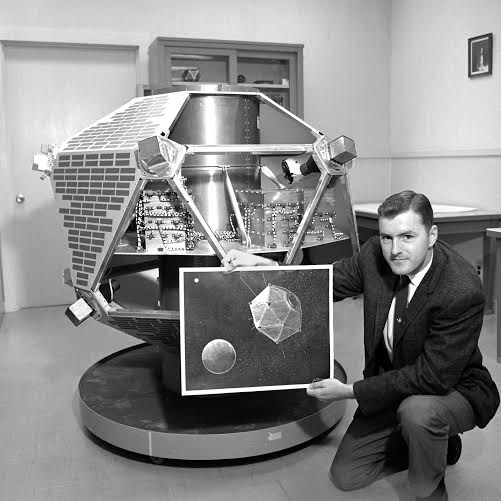 Dick Spalding
Creator of the DoD system that feeds bolide data to JPL.
Richard E. Spalding Foundation →
If you have, or want to acquire, an allsky camera and want to participate in the network, contact us at jchavez@spalding-allsky.net.
 JPL Fireball Reports
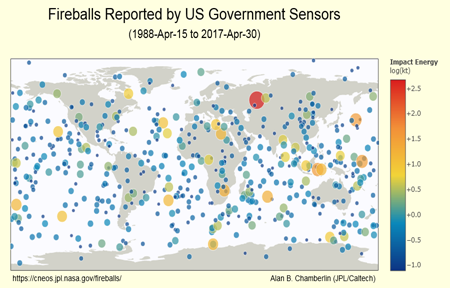
Fireballs reported by US Government sensors, 1988–2017 (a static snapshot — click it for the current JPL / CNEOS reports). Bolide light curves are now available on the JPL website.
Publications & Coverage
- The Creston, California Meteorite Fall and the Origin of L Chondrites — cites network data
- GOES/GLM Fireball Detections Correlated with the Spalding Allsky Camera Network
- Analysis of the June 2, 2016 bolide event over Arizona
- Orbit and origin of the LL7 chondrite Dishchii'bikoh (Arizona)
- IAWN: "Asteroid 2019 MO, The Latest Confirmed Small Impactor"
Selected Event Video
- Large Bolide (5kt) over the Caribbean (GLM, USG, CTBTO) — this impact was predicted (see the IAWN item above)
- Fragmenting bolide over British Columbia — recorded by COTR Cranbrook (Node 28)
- Large bolide over Arizona, 2016
- GLM/Allsky detection of the 12 Feb bolide near Florida
- GLM detection of the 1 Feb bolide over Cuba — also reported by JPL as 1.4kt total impact energy at 23.7km altitude
- GLM detection of the Falcon 9 rocket destruction on abort: video 1, video 2
- Russian rocket body reentry over the US
- Starlink constellation overflight, New Mexico
- SpaceX's Tesla does a burnout on Hohmann Road to the asteroid belt
- Fantastic auroral display over British Columbia
Partner & Reference Sites
 NASA Geostationary Lightning Mapper (GLM) bolide detections
- JPL / CNEOS Fireballs
 International Meteor Organization — current global events seen by ground observers
 Strewnify — local coverage of events for meteorite recovery (trajectories, impact points)
 Center for Orbital and Reentry Debris Studies — reentry predictions
- Cameras for Allsky Meteor Surveillance (CAMS) — SETI Institute
 CAMS Florida website (pick a date to view)

 NASA's All Sky Fireball Network (ASGARD)
 Heavens Above — daily predictions of brighter satellite overflights